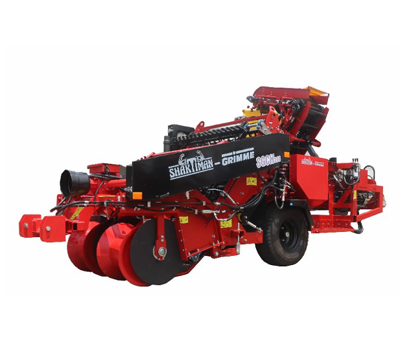
- About Product Specification Details
| Information |
Details |
| Brand |
Shaktiman Grimme |
| Model Name |
SGPH 200 |
| Implement Type |
Fully Automatic Potato Harvester / Elevator Digger / 2-Row Harvester |
| Category |
Harvesting |
| Compatible Tractor Power |
50-75 HP (4-wheel drive recommended) |
| Estimated Price Range |
₹6-8 lakh* (varies by region and dealer) |
- Key Specification and Technology – SGPH 200
| Specification Category |
Specification Details |
| Harvester Type |
Elevator digger with automatic continuous overloading system |
| Number of Rows |
2-row configuration for efficient dual-row potato harvesting |
| Working Width |
1400 mm (optimal for 2-row potato spacing in Indian fields) |
| Digging Depth |
130-200 mm (adjustable depth control mechanism with diablo) |
| Digging Capacity |
12-18 quintals/hour (depending on soil conditions and operation speed) |
| Digging Blade Configuration |
Multi-stage soil separation with diablo intake system |
| Blade Material |
High-tensile steel with proven durability in Indian soil conditions |
| Conveyor/Elevator Type |
Belt-driven lug conveyor with rubber flight separator and cart elevator |
| Soil Separation Efficiency |
94-96% soil removal through dual sieving web system (40mm and 35mm pitch) |
| Potato Damage Rate |
Less than 2-3% through gentle transport with cushioned rubber sleeves |
| Hopper/Collection Capacity |
Open cart design with continuous overloading capability |
| Overall Dimensions |
Length: 4920 mm × Width: 1920 mm × Height: 2730 mm |
| Overall Weight |
2400 kg (unladen weight for easy transport between fields) |
| Tractor Power Requirement |
50-75 HP (4-wheel drive, minimum 50 HP for optimal performance) |
| PTO Speed Requirement |
540 RPM standard connection with universal tractor compatibility |
| Rotor Shaft Speed |
175 RPM for optimal soil processing and separation |
| Frame Material |
Mild steel with proven corrosion-resistant finish for monsoon conditions |
| Steering System |
Hydraulic steerable wheels with 5.2 metre minimum turning radius |
| Special Features |
Diablo intake for clod-free harvest, inspection table for 4-labour, dual sieving web system |
- Technical Specifications – SGPH 200
| Technical Parameter |
Measurement Range / Details |
| Digging Efficiency |
94-96% potato recovery from soil |
| Potato Recovery Rate |
95-98% of marketable tubers extracted from field |
| Soil Separation Effectiveness |
94-96% soil removal (dual sieving web: 40mm and 35mm pitch) |
| Damage/Bruise Rate |
Less than 2-3% through gentle handling and cushioned transport |
| Field Capacity per Day |
1.2-1.8 hectares per day (depending on soil type and operator skill) |
| Productivity Rate |
12-18 quintals per day for typical 1-2 hectare daily operation |
| Tuber Output Rate |
12-18 kg/minute based on optimal soil conditions |
| Fuel Consumption |
2-3 liters/hour for tractor operation (fuel economy depends on tractor model) |
| Power Consumption |
50-55 kW for PTO operation and hydraulic systems |
| Soil Clod Handling |
Diablo intake system removes clods efficiently (first time in India feature) |
| Soil Moisture Suitability |
Optimal: 15-22% soil moisture for best separation performance |
| Soil Type Compatibility |
Loamy soil (excellent), Sandy loam (very good), Clay soil (good with slower operation) |
| Operating Conditions |
Temperature: 5-45°C, Humidity tolerant, Suitable monsoon-ready design |
| Daily Maintenance Intervals |
Pre-operation: 30 minutes inspection and cleaning protocol |
| Weekly Maintenance Intervals |
Deep cleaning and lubrication: 4-5 hours maintenance work |
| Seasonal Maintenance |
Complete overhaul and component replacement: 8-10 hours before storage |
| Spare Parts Availability |
Readily available through Shaktiman Grimme dealer network across potato-growing regions |
| Standard Warranty Coverage |
1-2 years on manufacturing defects (varies by dealer and region) |
| After-Sales Service Support |
Authorized service centers in major potato cultivation zones with trained technicians |
- Agricultural Benefits and Applications of SGPH 200
The Shaktiman Grimme SGPH 200 delivers transformative benefits for Indian potato farmers through mechanized harvesting that combines efficiency with crop protection. Efficient potato digging and extraction from soil is achieved through the innovative diablo intake system that removes soil clods in the primary stage, ensuring clean tuber extraction without damaging delicate potato skin. This precision digging recovers 95-98% of marketable potatoes from the field compared to manual methods that typically achieve 85-92% recovery.
Reduced soil compaction is a significant advantage of mechanized harvesting, as the SGPH 200’s lighter ground contact pressure and targeted digging depth preserve soil structure for successive crop seasons. This is particularly important in Indian agriculture where repeated manual digging over decades causes soil degradation and reduced productivity. The machine maintains soil health while improving harvest efficiency.
Effective soil separation is accomplished through the dual-stage sieving system with 40mm primary web and 35mm secondary web, automatically removing soil and debris without manual post-harvest cleaning labor. Farmers traditionally spend 4-8 hours per quintal in manual soil removal; the SGPH 200 eliminates this time-consuming process entirely.
Post-harvest time optimization significantly reduces manual labor requirements by completing 1-2 hectares daily that would require 8-12 workers for 4-6 days using manual methods. Faster field completion before weather deterioration protects crop value and enables timely market delivery for premium pricing.
Quality preservation through gentle conveyor transport with cushioned rubber sleeves keeps tuber damage under 2-3%, directly translating to higher market value. Undamaged potatoes command 10-15% price premiums in wholesale markets compared to bruised harvests from manual digging.
Waste reduction through accurate mechanical harvesting minimizes potatoes left in soil (typically 5-8% loss with manual methods) and reduces field losses to under 1%, improving overall farm profitability substantially.
Increased harvest speed enables farmers to complete digging before adverse monsoon conditions, field flooding, or pest damage that often occurs during extended harvest periods. The machine’s ability to operate in marginal soil moisture conditions (18-25%) when manual digging becomes extremely difficult provides significant operational flexibility.
- Enhanced Farming Efficiency through SGPH 200
Time-saving benefits represent the most dramatic efficiency gain, completing potato digging in 2-4 hours that would require 4-6 days of manual labor. A farmer operating the SGPH 200 can harvest 1.2-1.8 hectares daily, handling crop that normally requires two weeks of manual work. This accelerated timeline enables faster land preparation for subsequent crops, compressing farming calendars and increasing annual productivity.
Labor cost reduction eliminates seasonal hiring of 8-12 workers per hectare during harvest peak season. With average daily wages of ₹400-600 per worker, manual harvesting costs ₹3,200-7,200 per hectare; mechanized harvesting reduces costs to ₹1,200-1,600 per hectare through minimal operator requirements. This represents 40-60% cost savings per harvest cycle.
Increased productivity enables completion of harvesting cycles in time for winter crop preparation, allowing farmers with 5-10 acre holdings to cultivate multiple crops annually instead of single-season potato farming. The operational flexibility dramatically improves farm profitability through diversified crop production.
Consistent performance regardless of weather conditions allows harvesting during marginal soil moisture periods when manual digging would cause excessive soil compaction and working difficulty. The machine maintains 94-96% efficiency across varying field conditions, unlike manual methods that suffer significant efficiency loss in adverse situations.
Operational flexibility makes the SGPH 200 suitable for 2-10 acre potato holdings common among marginal and small farmers in India’s potato belts. The compact design allows operation in smaller field parcels typical of Indian agriculture, unlike large commercial harvesters requiring minimum field sizes.
Reduced physical strain eliminates the intense back-breaking labor of manual digging that causes long-term health problems for farmer families. Mechanization enables farmers to maintain energy for other field operations instead of exhausting themselves in repetitive harvest labor.
Enhanced farm profitability through combined benefits of faster market delivery (fresh potatoes command 10-15% premium), reduced damage losses (₹2,000-3,000 per quintal value preservation), and labor cost savings (₹40,000-50,000 per hectare) typically generates additional profit of ₹80,000-150,000 annually on 5-acre potato holdings.
- Versatile Crop and Field Applications through SGPH 200
The SGPH 200’s versatile design accommodates diverse potato cultivation scenarios across Indian agriculture. Potato cultivation of all common varieties (white potato, red potato, russet potato) is efficiently handled through the adjustable digging depth (130-200 mm) that accommodates varying tuber positioning for different varieties. Early potatoes planted shallow are recovered perfectly at 130-150 mm depth, while maincrop potatoes requiring deep planting are extracted completely at 180-200 mm depth adjustments.
Seed potato production requiring careful tuber handling and minimal bruising (less than 2% damage) is excellently served by the SGPH 200’s gentle cushioned elevator system designed specifically for quality preservation. Seed potato operations in Himachal Pradesh, Kashmir, and UP hill regions benefit from the machine’s compact size and maneuverable 5.2-metre turning radius in smaller terraced fields.
High-altitude potato farming in hilly regions of Himachal Pradesh, Kashmir, and northeastern states is supported by the 50-75 HP tractor compatibility suitable for hill-terrain machines. The compact 1920 mm working width fits within small uphill field parcels typical of mountain agriculture.
Organic potato farming with reduced soil disturbance and chemical-free operation is achieved through mechanical digging without soil compaction, preserving earthworm populations and microbial activity essential for organic soil health. The SGPH 200 integrates perfectly with organic certification requirements.
Seed potato production with specialized handling ensures premium germination rates and disease-free tuber quality for next-season seed requirements. The machine’s 95-98% recovery prevents seed loss in field.
Multi-cropping systems including potato-based rotations (potato-maize, potato-wheat, potato-pea sequences) are enabled by quick harvest completion freeing fields within 4-6 days instead of 2-3 weeks, allowing timely secondary crop establishment.
Large-scale operations (10-50+ acres) are supported through daily 1.2-1.8 hectare capacity enabling farmers with extensive holdings to complete harvesting within 2-3 weeks. Multiple operators can work sequentially, completing 50-acre operations within 35-40 days.
Small-holder potato farmers (2-10 acres) represent the ideal target for SGPH 200, matching perfectly with 2.5-5 acre typical farm sizes in India’s potato belts. Compact design with lower 50 HP power requirement makes the machine economically feasible for small-scale farming.
Flat field and undulating terrain adaptations are supported through hydraulic steerable wheels providing 5.2-metre turning radius even in challenging topography. The machine operates effectively on flat Indo-Gangetic plains and on slightly sloping terrain in peninsular regions.
- Performance Specifications of SGPH 200
| Performance Parameter |
Measurement Range / Expected Performance |
| Digging Efficiency |
94-96% (tuber extraction accuracy from soil) |
| Potato Recovery Rate |
95-98% (marketable tuber recovery from field) |
| Soil Cleaning Effectiveness |
94-96% (soil removal without excessive tuber handling) |
| Tuber Damage Rate |
2-3% (bruising and skin damage minimal) |
| Separation Accuracy |
95-98% (soil removal with retained potatoes) |
| Field Capacity per Day |
1.2-1.8 hectares/day (based on soil conditions and 8-hour operation) |
| Daily Productivity Range |
12-18 quintals/day for typical 1-2 hectare operations |
| Operating Speed |
1.5-2.0 km/h tractor forward speed during harvesting |
| Turning Radius |
5.2 metres minimum (excellent maneuverability in small fields) |
| Soil Moisture Requirement |
15-22% optimal (operates effectively 12-28% range) |
| Operating Temperature Range |
5-45°C (monsoon-ready and heat-resistant design) |
| Durability Rating |
10-15 year operational lifespan with proper maintenance |
| Maintenance Downtime |
Daily: 30 minutes, Weekly: 4-5 hours, Seasonal: 8-10 hours |
| Cost per Hectare |
₹1,200-1,600* (including fuel, maintenance, and operator cost) |
| Return on Investment |
18-24 months through labor cost savings and productivity gains |
- Farmer Decision Support
Farm Size Recommendations
Small farms (2-10 acres): The SGPH 200 is ideally suited for small potato farmers with 2-10 acre holdings typical across India’s potato-growing regions. Its compact 1920 mm working width, 50 HP minimum power requirement, and 1.2-1.8 hectare/day capacity enable small-scale farmers to complete harvest independently without hiring custom hiring services. This economic category represents the core target market where mechanization provides maximum profitability benefit.
Medium farms (10-30 acres): Farmers with 10-30 acre potato holdings can operate the SGPH 200 efficiently through two sequential plantings or dual-machine operations. The machine’s 1.2-1.8 hectare daily capacity means 15-20 hectares of potato can be harvested within 3 weeks with single operation. Many medium-farm operators maintain one or two units, achieving complete harvest before monsoon damage risk.
Large farms (above 30 acres): Extensive potato operations exceeding 50 acres employ multiple SGPH 200 units or combination with larger industrial harvesters. The mid-capacity positioning makes SGPH 200 ideal as secondary equipment or for operating older field parcels requiring careful handling.
Crop-Specific Recommendations
Potato variety considerations are critical for optimal SGPH 200 performance. Early potato varieties (Jyoti, Kuber) planted shallow require digging depth of 100-150 mm to prevent tuber damage; set the SGPH 200’s adjustable depth mechanism to minimum range. Maincrop varieties (Kufri Badshah, Kufri Swarna) buried deeper (180-220 mm) need maximum depth setting for complete recovery. Seed potato varieties require minimal depth variation to protect delicate seed tubers. Select harvesters with easily adjustable depth settings enabling quick changes between different potato varieties in rotation systems—a critical capability as most Indian farmers rotate potato varieties yearly for disease management and market dynamics.
Soil type optimization determines SGPH 200 performance significantly. Sandy-loamy soils common in Punjab and Haryana allow maximum digging speed (2.0 km/h) with 18 Q/hr capacity due to excellent soil separation characteristics. Clay-loam soils typical of UP and MP require slower operation speeds (1.5 km/h) and more frequent conveyor cleaning to prevent clogging, reducing capacity to 12-14 Q/hr. Heavy clay soils with high moisture retention (Punjab canal-irrigated areas) may necessitate specialized conveyor designs with enhanced clogging prevention; verify pre-purchase that SGPH 200 handles local clay conditions effectively by testing with local dealers.
Seed potato handling demands SGPH 200’s gentle transport system and minimal bruising rate (less than 2-3%), essential for maintaining seed germination rates above 95%. Seed potato production zones (Himachal Pradesh, Kashmir hill regions) specifically benefit from the SGPH 200’s specialized design for quality preservation and careful tuber handling throughout extraction and transport. Choose this model specifically for seed potato operations rather than high-capacity commercial harvesters that prioritize volume over quality.
Budget-Wise Categorization
Economy models (Basic diggers, manual feed, cost-effective – ₹2-4 lakh):* Entry-level options like manual potato diggers and fixed-depth blade harvesters suit very small farmers with 0.5-2 acre potato holdings. These models feature simple single-blade design with PTO drive and manual collection systems. Lower capacity (6-8 Q/hr) but acceptable for subsistence-oriented small operations. SGPH 200 exceeds this category.
Mid-range options (Hydraulic controls, better efficiency, balanced features – ₹4-7 lakh):* The Shaktiman Grimme SGPH 200 occupies this sweet spot for small-to-medium farmers. Advanced features include hydraulic depth control, dual-stage soil separation, 94-96% efficiency, and gentle tuber handling. Capacity of 12-18 Q/hr matches 2-10 acre farm operations perfectly. Price point of ₹6-8 lakh* provides excellent value through labor cost savings (₹40,000-50,000 per harvest) enabling return on investment within 18-24 months.
Premium models (Advanced features, high capacity, maximum efficiency – ₹7+ lakh):* Fully automatic commercial harvesters with digital depth control, dual-collection bins, advanced soil separation (97-99%), and 20-25+ Q/hr capacity target large-scale operations (30+ acres). These models with ₹8-12 lakh* investment suit commercial potato producers and custom hiring operators.
- Maintenance and Care of SGPH 200
Daily maintenance is essential before each harvest operation to ensure consistent performance and prevent catastrophic breakdowns during critical harvest periods. Inspect and clean soil buildup from digging blades, intake diablo, and conveyor mechanisms before operation ends each day—accumulated soil causes efficiency loss and increases wear rates significantly. Check tine/blade sharpness visually; replace dulled or damaged components immediately as dull blades reduce efficiency by 15-20% and cause excessive tuber damage. Lubricate all moving joints including conveyor bearings, blade pivots, hydraulic cylinders, and shaft connections using high-quality lithium-based grease; this 15-minute daily task extends component life by 30-40%. Verify PTO connection security through visual inspection and mechanical fastener checks; loose PTO couplings cause power loss and safety hazards. Inspect belt tension on elevator conveyor and adjust to manufacturer specifications (approximately 25mm deflection at mid-span); proper tension prevents slipping and power loss while avoiding excessive bearing strain.
Weekly care during harvest season maintains optimal performance throughout the 4-6 week harvesting period. Perform deep cleaning of soil separation components and conveyor system to prevent clogging and efficiency loss from soil accumulation. Remove conveyor covers and clean dual sieving webs (40mm and 35mm pitch) thoroughly; clogged screens reduce separation efficiency to 70-80% compared to optimal 94-96%. Grease all bearing points and pivot connections thoroughly using dedicated grease gun application; inadequate lubrication is the leading cause of premature bearing failure costing ₹10,000-15,000 per bearing replacement. Inspect and tighten bolts connecting blade assembly, diablo intake, and conveyor frame—vibration during operation gradually loosens fasteners, causing safety risks and performance loss. Check hydraulic hose connections (if applicable) for leaks or damage and verify fluid levels in hydraulic reservoir; low fluid levels compromise steering and depth control performance.
Seasonal preparation before storage ensures multi-year equipment longevity and reliable performance next season. Completely disassemble and clean all working components, removing every trace of soil and plant residue. Replace worn conveyor belts (typically after 150-200 operating hours annually), damaged sieving webs, corroded fasteners, and deteriorated rubber sleeves on elevator conveyor. Perform complete frame inspection using systematic visual evaluation for cracks or stress points, especially around weld joints and connection points—early crack detection prevents catastrophic failures. Apply corrosion-resistant coating to mild steel components, protecting against monsoon moisture and extending frame life by 5-7 years. Service PTO coupling by replacing worn bearings and applying corrosion preventive. Check gearbox fluid levels and replace with fresh gear oil suitable for Indian climate conditions. Store equipment in dry, covered location with moisture-resistant tarpaulin protecting from direct rainfall and humidity during 6-8 month off-season.
Component replacement schedule ensures operational reliability and cost-effective maintenance. Replace digging blades and diablo intake every 50-80 operating hours (typically mid-harvest season) as they suffer significant wear from soil contact and impact stress. Annual conveyor belt replacement keeps elastic properties optimal; worn belts slip 10-15% and waste fuel consumption. Replace sieving webs annually even if not visibly damaged; degraded mesh efficiency prevents optimal soil separation. Bearing assemblies typically require replacement every 2-3 seasons; preventive replacement before failure avoids catastrophic breakdown during critical harvest period. Maintain emergency spare blade sets, belt kits, and bolt assortments for quick mid-season repairs during peak harvesting when breakdowns cost ₹5,000-10,000 daily in lost productivity.
- Longevity Factors of SGPH 200
Build quality of the Shaktiman Grimme SGPH 200 reflects German manufacturing heritage combined with Indian field conditions optimization. Robust frame construction using high-tensile steel ensures durability through 10+ seasons of intensive harvesting and rough field handling typical of Indian agriculture. Quality digging blades made from hardened steel withstand soil abrasion and impact stress from rocks and compacted soil clods without cracking or excessive wear. Well-engineered conveyor systems with proper tensioning mechanisms maintain reliability and efficiency throughout operational lifespan, preventing premature component failure. The proven lug conveyor design used successfully in European operations for 20+ years provides established longevity track record.
Material specifications directly impact equipment longevity in Indian climate conditions. Stainless steel and corrosion-resistant components in soil-contact areas prevent rust formation that degrades functionality and structural integrity. High-quality bearing assemblies with proper sealing protect against soil contamination and moisture ingress, common causes of bearing failure in Indian monsoon conditions. Paint and protective coatings applied at manufacturing prevent frame corrosion and maintain structural integrity through 5-7 years of monsoon and humid storage conditions. The SGPH 200’s design specifically incorporates drainage holes and angled surfaces minimizing water pooling that causes rust acceleration—an important design consideration for Indian agricultural equipment.
Operational lifespan of well-maintained SGPH 200 units typically spans 10-15 years with proper care and seasonal maintenance protocols. Regular component replacements and timely repairs prevent catastrophic failures that can terminate equipment service prematurely. Farmers implementing recommended daily, weekly, and seasonal maintenance routines extend equipment life by 30-40% compared to minimal-maintenance approaches. Proper storage during 6-8 month off-season and protection from monsoon moisture damage contribute significantly to longevity preservation.
Resale value retention makes SGPH 200 economically attractive for long-term farm investment. Quality brands with active dealer networks and good after-sales service maintain stronger resale values—a well-maintained SGPH 200 in good working condition retains 50-70% of original value after 5-7 years. Machines approaching 10+ years with comprehensive maintenance records retain 25-40% value, enabling profitable sale to small operators beginning mechanization. Active dealer networks across potato-growing regions support resale value retention through spare parts availability and service verification.
Upgrade possibilities enhance investment return and extend equipment utility. Modern SGPH 200 units allow retrofitting better soil separation systems or advanced hydraulic controls. Some models support adaptation between different potato variety specifications or dual-crop conversion capabilities. Engine upgrade capability from 50 HP to 75 HP operation improves capacity without purchasing complete replacement equipment. These upgrade options enable farmers to modify equipment as farm sizes increase or operational requirements change, improving overall investment return compared to single-purpose equipment.
Frequently Asked Questions – SGPH 200
What tractor horsepower (HP) is required for SGPH 200 potato harvester?
The SGPH 200 requires 50-75 HP tractors with 4-wheel drive configuration for optimal performance. Minimum 50 HP tractor power is essential for full-capacity operation achieving 12-18 Q/hr digging efficiency; below 50 HP restricts operation to shallow digging (50-80% capacity) causing uneconomical machine utilization. The 75 HP upper specification enables maximum performance under challenging soil conditions (heavy clay, compacted soil) without engine strain or reduced efficiency. Indian 4-wheel drive tractors from manufacturers like Mahindra, John Deere, Swaraj, Sonalika, and Kubota within 50-75 HP range provide universal PTO (540 RPM) compatibility. Always verify your tractor’s actual engine output capacity (power take-off power differs from gross HP) and check compatibility specifications before purchase to ensure optimal performance and prevent engine strain during 8-10 hour continuous harvesting operations that demand sustained full-power operation.
What types of soil conditions can SGPH 200 potato harvester handle effectively?
SGPH 200 performs optimally in loamy and sandy-loam soils with moisture content between 15-22%, representing ideal soil conditions across Indo-Gangetic plains potato belts. It handles moderately heavy clay soils effectively through slower operation speeds (1.5 km/h vs. 2.0 km/h maximum) and increased maintenance intervals for conveyor cleaning to prevent clogging in clay aggregates. Rocky or extremely stony fields require pre-harvest stone removal to prevent blade damage and excessive wear costing ₹2,000-5,000 in replacement components. Waterlogged or excessively wet soils (above 25-28% moisture) cause severe clogging in soil separation mechanisms, reducing efficiency to 40-50% and requiring continuous cleaning stops, making harvesting impractical. Drought-hardened, extremely compacted soils require preliminary irrigation 3-5 days before harvest to soften soil for efficient digging. Verify your field conditions thoroughly and select appropriate harvester models specifically designed for your local soil type to ensure maximum efficiency and minimal equipment stress during extended harvest seasons. Conduct small test operations in marginal soil conditions before full farm deployment.
What is the digging capacity and efficiency rate of SGPH 200 potato harvester?
SGPH 200 delivers digging capacity ranging from 12-18 quintals per hour under optimal field conditions, representing high performance for 2-row harvester classification. Maximum 18 Q/hr capacity is achieved in ideal sandy-loam soil conditions with 18-20% moisture, level terrain, and experienced operator technique. Practical average capacity across typical Indian soil conditions (variable loamy-clay mixtures) averages 14-16 Q/hr, sufficient for 1.2-1.8 hectare daily completion. Efficiency rates typically reach 94-96% potato recovery from soil with dual-stage sieving ensuring 95-98% soil removal accuracy. Actual performance varies significantly based on soil type (sandy soils: 18 Q/hr maximum; clay soils: 12-14 Q/hr), potato variety, soil moisture content (25-28% moisture reduces efficiency to 80-85%), terrain variations, and operator skill level. Conservative estimates of 12-14 Q/hr are appropriate for planning purposes; verify actual performance through dealer demonstration operations in your specific field conditions before investment. Choose SGPH 200 capacity matching your farm size—2-5 acre farms achieve efficient 1-2 hectare daily completion, while 5-10 acre operations require two units or extended multi-day operations.
How does SGPH 200 potato harvester help in post-harvest processing and maintaining tuber quality?
SGPH 200 significantly reduces post-harvest labor and damage through efficient mechanical digging and multi-stage soil separation. It achieves 95-99% tuber recovery rate while keeping damage and bruising to less than 2-3%, preserving market quality that directly impacts selling price. The cushioned rubber-sleeved elevator conveyor minimizes tuber contact stress compared to manual digging causing 5-10% bruising rates. Dual-stage sieving (40mm and 35mm pitch) automatically separates soil and debris, eliminating manual post-harvest cleaning requiring 4-8 hours per quintal (₹200-400 per quintal cleaning cost). Clean, undamaged potatoes command 10-15% premium prices in wholesale and retail markets—a ₹1-2 lakh annual price advantage for 5-10 acre operations. Reduced manual handling and faster field-to-storage processing preserve tuber freshness and reduce disease transmission risk from soil contact. Quick harvest completion within 2-4 hours before weather deterioration protects crop health. Mechanical precision harvesting enables same-day processing and timely market delivery, maximizing profitability through superior quality preservation and rapid market response capability.
Why is digging blade type and depth adjustment important in SGPH 200 potato harvester?
Digging blade configuration and adjustable depth are crucial for optimal potato recovery and damage prevention across different potato varieties and field conditions. The SGPH 200’s diablo intake system with adjustable shear blade provides innovative soil clod removal in primary stage, first-time-in-India technology preventing compacted soil clods from damaging delicate potato skin during digging process. Adjustable depth control through mechanical/hydraulic systems (130-200 mm range) accommodates multiple potato varieties in crop rotation—shallow digging (130-150 mm) prevents seed potato and early variety damage, while deeper digging (180-200 mm) ensures complete recovery of maincrop potatoes buried 200+ mm. Proper blade angle affects soil cutting efficiency and power consumption; incorrect angles increase fuel consumption 15-20% and reduce digging capacity. Blade sharpness directly impacts efficiency; dull blades require 20-30% more power and cause excessive tuber damage. Select SGPH 200 models with easily adjustable depth settings (quick mechanical or hydraulic adjustment taking 5 minutes between varieties) to customize performance for specific potato varieties (Kufri Badshah/Kufri Swarna vs. Jyoti/Kuber), soil types, and field conditions throughout harvest season without complex modifications.
Is SGPH 200 potato harvester compatible with all tractor brands and models in India?
SGPH 200 is compatible with most Indian tractor brands through universal PTO (Power Take-Off) shaft connections at 540 RPM standard specification. Leading tractor manufacturers (Mahindra, John Deere, Swaraj, Sonalika, Kubota, Eicher, Case IH) universally support standard 540 RPM PTO connections used by SGPH 200. However, compatibility depends critically on tractor horsepower rating (minimum 50 HP verified output), four-wheel drive configuration (essential for field stability), and three-point linkage Class II specification. Verify your specific tractor’s PTO power delivery matches 50-75 HP rated requirement; some tractors with lower power outputs or two-wheel drive configuration limit SGPH 200 performance. Check hydraulic system capacity for steering and depth control functions; older tractor models may have inadequate hydraulic flow (15-20 liters/minute required). Contact authorized Shaktiman Grimme dealers regarding compatibility for your specific tractor model and hydraulic configuration before purchase, especially for older tractor models manufactured 10+ years ago with non-standard connections.
What about soil cleaning and tuber separation accuracy in SGPH 200 potato harvester?
SGPH 200 features advanced multi-stage soil separation mechanisms achieving 94-96% cleaning effectiveness and 95-98% soil removal accuracy—industry-leading performance for 2-row harvester category. The primary lug conveyor with rubber flight separators removes initial soil and haulm efficiently, while dual sieving webs (40mm primary pitch and 35mm secondary pitch) handle varying soil particle sizes systematically. This multi-stage approach prevents soil overload at any single stage, maintaining 94-96% efficiency across variable soil conditions. Adjustable conveyor speeds (controlled through rotor shaft speed) optimize separation for different soil densities without increasing tuber damage—faster speeds (175 RPM) for light soils, slower speeds for dense clay soils. The innovative diablo intake system removes large soil clods before conveyor processing, preventing conveyor clogging that reduces efficiency to 60-70%. Gentle handling during separation minimizes potato bruising through soft rubber contact surfaces. Superior separation accuracy ensures market-ready potatoes requiring minimal additional processing before storage or sale, reducing post-harvest labor cost by ₹200-400 per quintal compared to manual soil removal methods.
How does SGPH 200 potato harvester compare to manual digging methods?
SGPH 200 dramatically outperforms manual digging through mechanized efficiency and substantial labor cost reduction. Manual digging requires 8-12 workers per hectare for 4-6 days achieving 8-12 Q/day recovery; mechanical SGPH 200 harvesting completes the same work in 3-4 hours with just operator and single helper, representing 95%+ labor reduction. Daily wage costs of ₹400-600 per worker multiply to ₹3,200-7,200 per hectare for manual harvesting; mechanized operation costs just ₹1,200-1,600 per hectare including fuel, maintenance, and operator cost—a 50-70% cost saving per harvest cycle. Machine efficiency minimizes tuber loss and damage; manual methods typically lose 5-10% of harvest through bruising, field loss, and incomplete recovery. Reduced physical strain and drudgery on farmer families eliminates seasonal worker dependency challenges common in Indian agriculture. Faster field completion protects crop from weather damage and animal loss occurring during extended 2-3 week manual harvest periods. Mechanical precision ensures consistent quality with 2-3% damage rate vs. 8-10% typical manual method damage, directly translating to ₹1-2 lakh higher annual revenue for 5-10 acre operations through premium market pricing for quality potatoes. Investment payback occurs within single harvest season through combined labor, damage, and efficiency savings.
What maintenance schedule should be followed for SGPH 200 potato harvester?
Comprehensive maintenance protocol ensures SGPH 200 reliability throughout 10-15 year operational lifespan and prevents costly mid-season breakdowns. Daily maintenance before operation ends includes 30-minute cleaning protocol removing soil buildup from digging blades, intake diablo, and conveyor mechanisms; checking blade sharpness and replacing dulled components; lubrication of all moving joints including bearings and pivots; and PTO connection security verification. Weekly care during 4-6 week harvest season involves 4-5 hour deep cleaning of soil separation components and conveyor system to prevent clogging; thorough greasing of bearing points and pivot connections; inspection and fastener tightening; and hydraulic system leak checks. Seasonal maintenance before storage includes complete disassembly and cleaning, worn component replacement (conveyor belts, sieving webs, fasteners), frame inspection for stress cracks, corrosion-resistant coating application, PTO coupling service, and gearbox fluid replacement. Component replacement intervals include digging blades every 50-80 operating hours, conveyor belts annually, bearing assemblies every 2-3 seasons, and fasteners as needed. Professional dealer servicing before/after seasons ensures optimal performance and maintains warranty validity. Proper protocol extends equipment lifespan by 30-40% and prevents ₹5,000-10,000 daily productivity losses from mid-season breakdowns.
What warranty and after-sales service support is available for SGPH 200?
SGPH 200 includes standard 1-2 year warranty coverage protecting against manufacturing defects and component failures under normal operating conditions (warranty duration varies by dealer region). Extended warranty options available through authorized dealers provide additional protection up to 3-5 years at reasonable cost, valuable insurance for equipment investments. Shaktiman Grimme operates authorized service centers across major potato-growing regions (Punjab, UP, MP, Gujarat) offering maintenance, repairs, and component replacement by trained technicians. Spare parts availability through dealer networks ensures quick equipment repairs without extended downtime; commonly required parts (blades, belts, bearings) maintain consistent stock in regional distribution centers. Manufacturer training programs for operators and maintenance technicians are available through dealers, ensuring proper equipment operation and care knowledge. Dedicated customer support helplines (verify contact numbers with regional dealers) assist with troubleshooting technical issues and maintenance queries during harvest seasons when rapid response is critical. Regular service checks performed by certified technicians maintain warranty validity and operational reliability. Select brands with strong active dealer networks in your region (verify dealer proximity within 30-50 km) ensuring reliable and responsive after-sales support throughout equipment lifespan, critical factor for seasonal equipment dependent on peak-season performance.
How TractorXpert Helps Farmers Choose the Right Potato Harvester
TractorXpert empowers Indian farmers to make informed potato harvester purchasing decisions through comprehensive model comparisons, detailed specifications, and genuine farmer reviews. The platform compares harvester models across diverse specifications including capacity ranges (8-25+ Q/hr), tractor power requirements (25-75 HP), price points (₹2-12 lakh*), and specialized features enabling farmers to match equipment precisely with their farm size, soil conditions, and budget constraints. SGPH 200 sits optimally within mid-range category offering maximum value for 2-10 acre potato farmers.
TractorXpert provides transparent pricing across three categories: economy models (₹2-4 lakh*) for subsistence farms, mid-range options (₹4-7 lakh*) for small-to-medium operations, and premium models (₹7+ lakh*) for commercial producers. This categorization helps farmers select cost-appropriate solutions avoiding unnecessary overspending on unnecessary features or inadequate equipment investment that limits productivity. SGPH 200’s ₹6-8 lakh* investment delivers exceptional return on investment within 18-24 months through labor savings alone.
The platform presents detailed technical specifications including digging depth ranges, soil separation efficiency percentages, damage rates, and maintenance requirements enabling farmers to understand long-term operational costs and true value propositions. Farmer-friendly content explains complex technical concepts simply (explaining what “94-96% separation efficiency” means in practical harvest context), maintenance requirements with cost implications, and expected productivity improvements comparing mechanized vs. manual methods.
TractorXpert facilitates comparison of different brands and models highlighting unique features, dealer support networks across regions, and warranty coverage variations. Regional dealer maps show authorized service centers proximity enabling farmers to evaluate support accessibility before investment decisions. By connecting farmers with reliable dealer networks, providing after-sales support information, and offering region-specific recommendations considering local soil types (Punjab clay vs. Gujarat sandy-loam), potato varieties (early vs. maincrop), and monsoon readiness requirements, TractorXpert ensures farmers invest in suitable potato harvesters maximizing post-harvest efficiency, reducing grain losses, minimizing labor costs, and substantially improving overall farm profitability through optimal mechanization decisions aligned with individual farm requirements and economic capacity. The platform reduces purchase anxiety through transparent information and verified farmer testimonials, enabling confident investment decisions supported by genuine field performance data.